HRPulsar is an open-source HR platform that keeps human judgment and accountability at the center as AI agents join the team. Describe a process and see which steps an agent can take, which stay with people, and who checks the agent's work. Self-host or cloud.
Most companies still can't answer four questions about their own work:
Who answers for what an agent did?
An agent has no manager and no job title. Unless a named person owns each access to it, nobody does.
Which step of your process goes to an agent?
Vendors say most of it. Your team says none. Both answer for the whole job.
Which skills does your team already have?
Titles and org charts don't say what people can actually do.
Who is ready to work with AI?
Adoption is uneven, and self-reported confidence is not a signal.
Without a named person behind each step, handing work to agents stalls at the first meeting.
Coverage answers per step. The modules below are the data it stands on: skills, assessments, grades, hiring and development in one system. All of it ships today — open the tour or the demo and see for yourself.
Plan the work
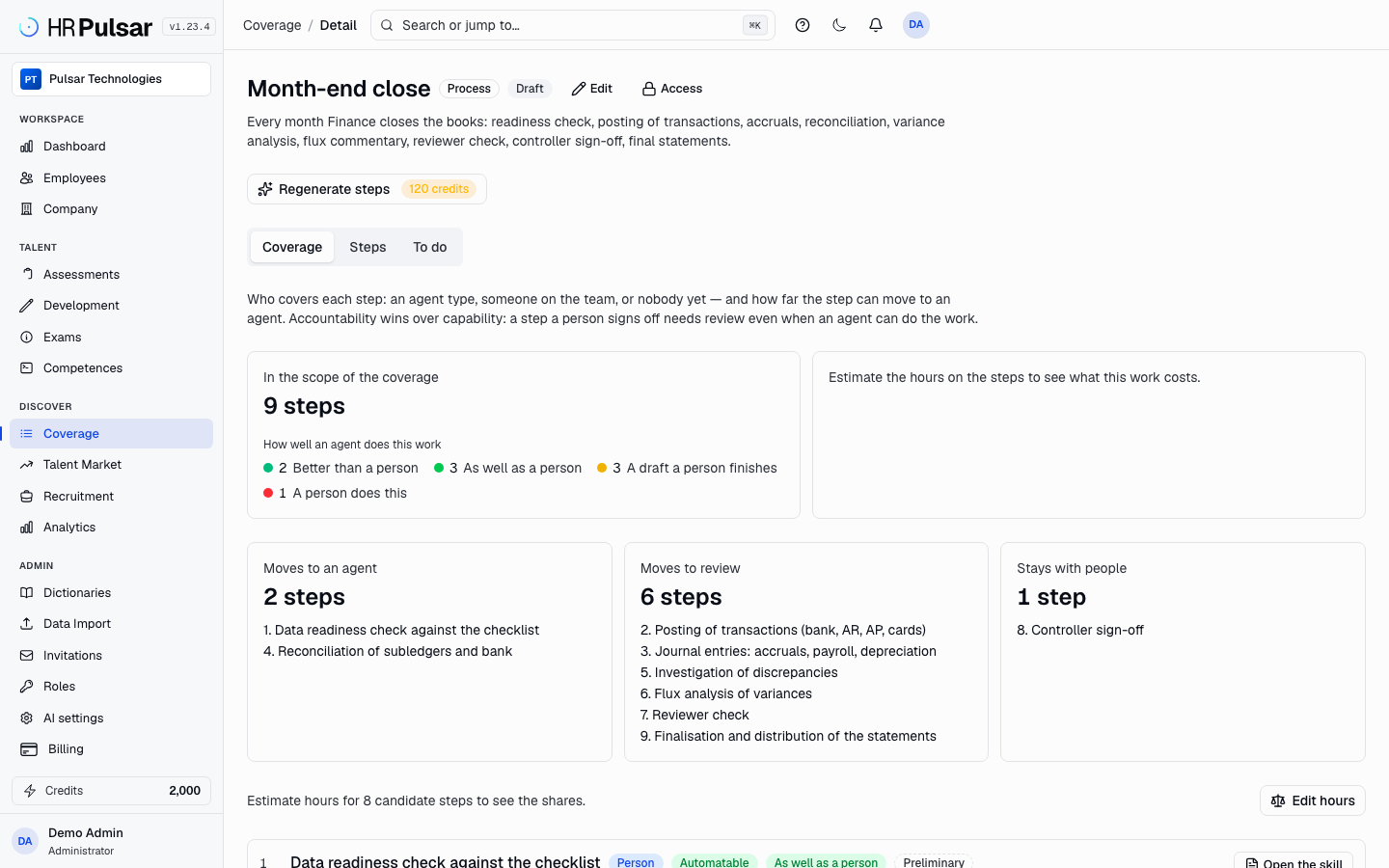
Describe a process. See which steps an agent can take, which stay with people, and where nobody covers it yet.
See how Coverage works →
Define & measure
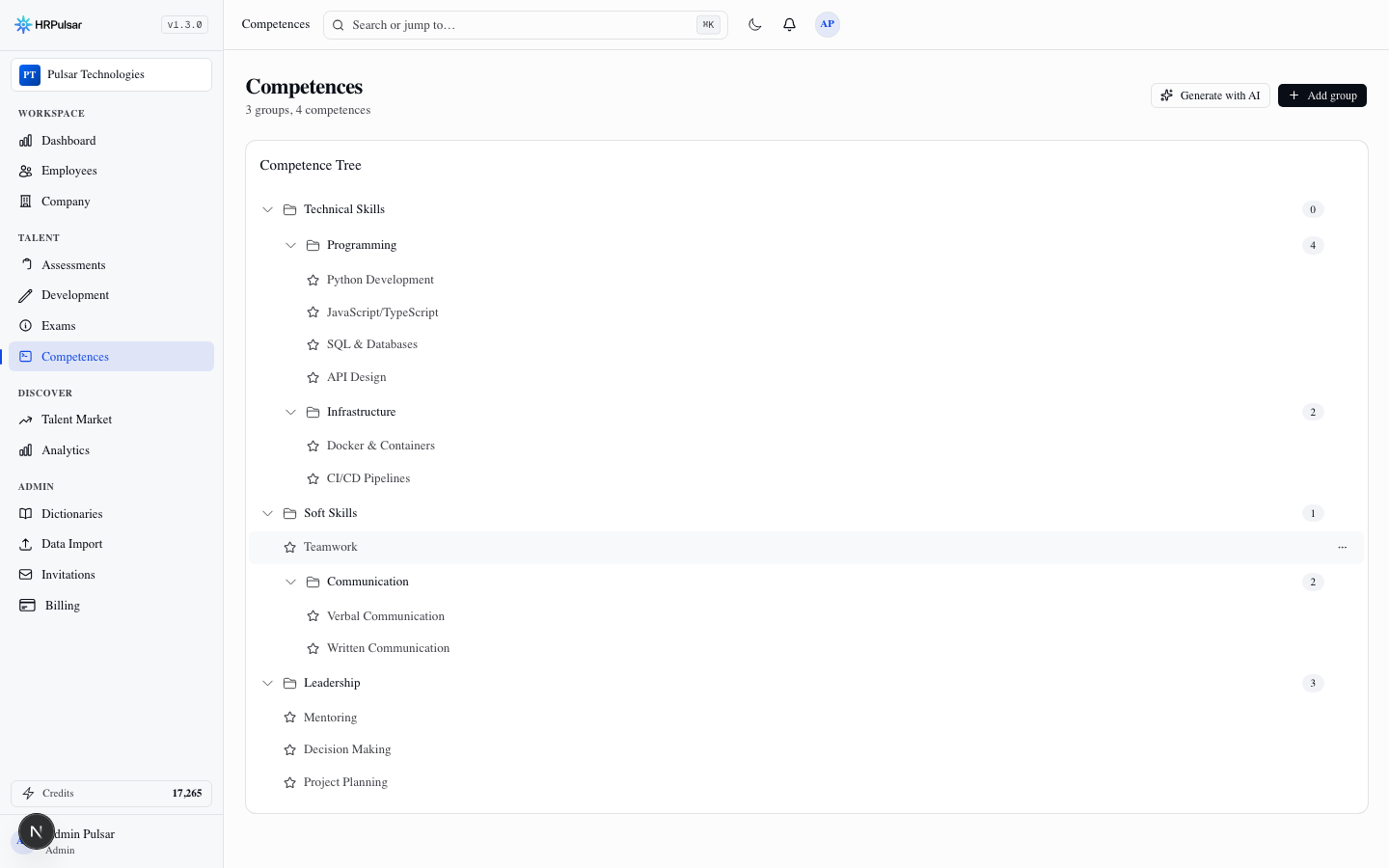
Model the skills your company needs, then check them with assessments and exams.
Hire & mobilize
Bring demonstrated skills in from outside — or find them on teams you already have.
Develop & promote
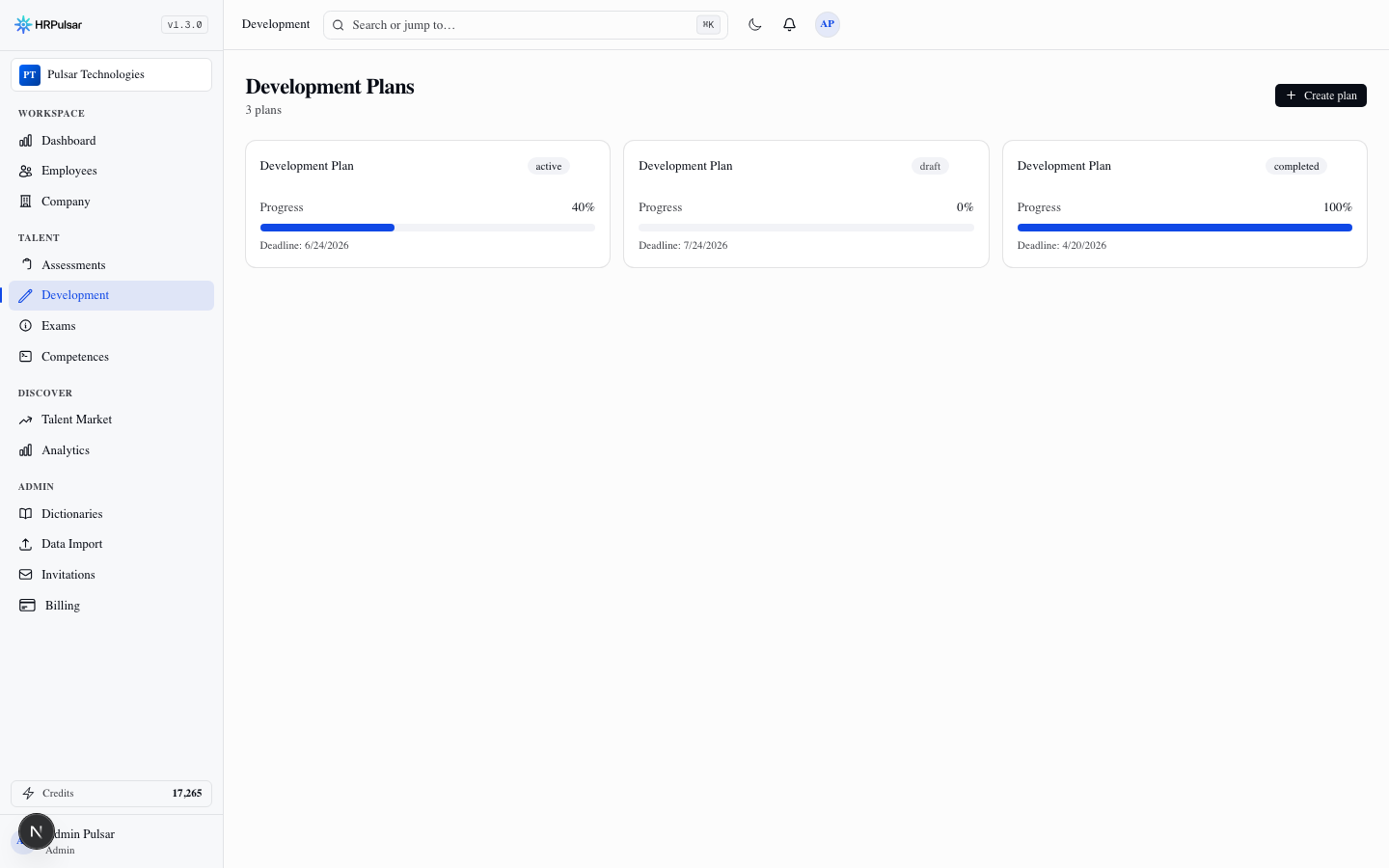
Close the measured gaps and connect growth to a career ladder people can see.
The AI layer
Not a separate module — it works inside every module above.
Framework generation, semantic search and suggestions across every module.
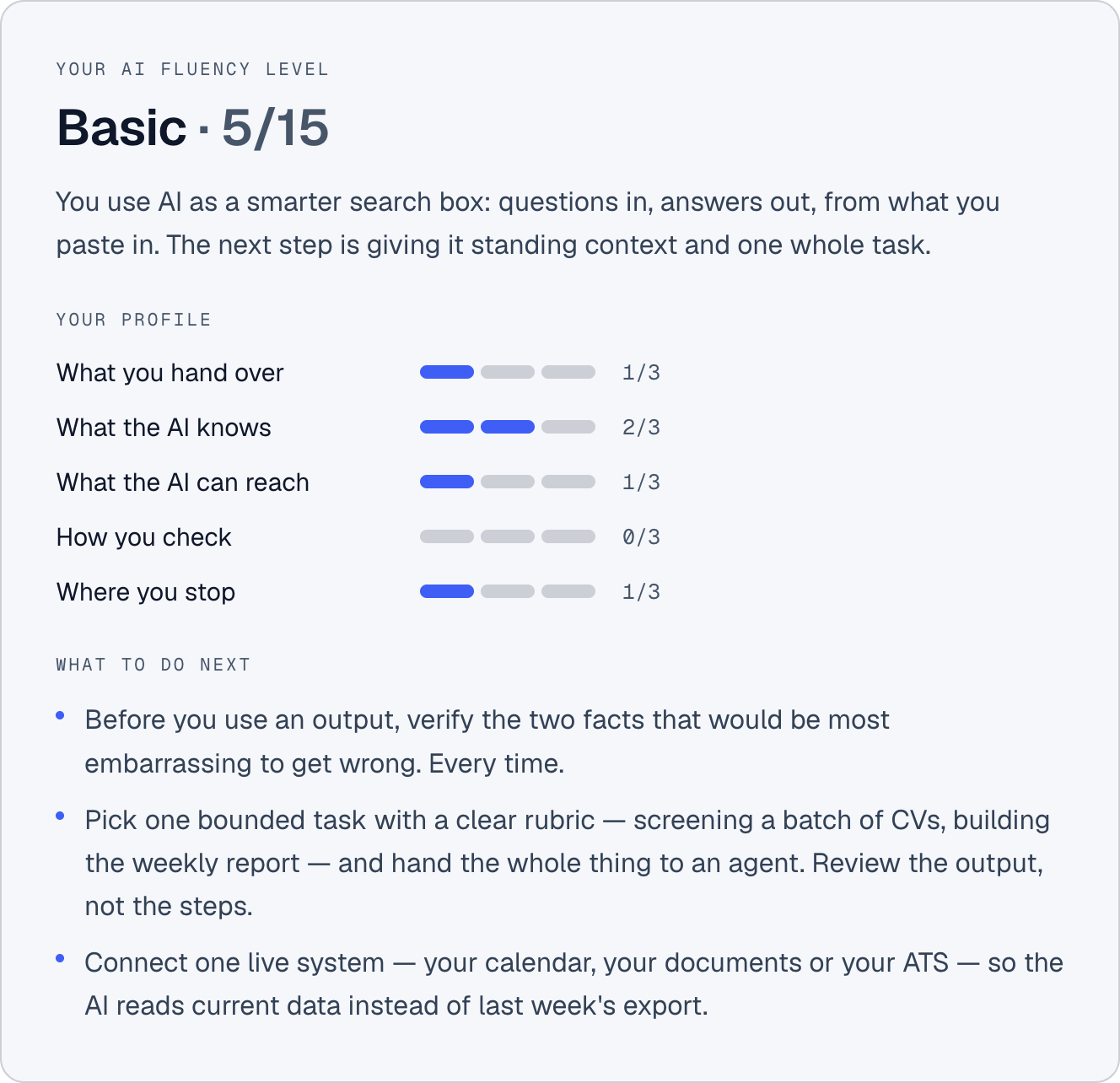
AI Fluency is an observable skill, not self-reported confidence. The scale has five behavioural dimensions and three levels, inspired by Reid Hoffman's three levels. It is public, and the five-question self-assessment runs in your browser.
Inside the product the score is in development, built on the assessments the platform already runs.
Agents are tools. A person answers for each access to one, a person makes every hiring decision, and the data stays where you put it. Behind every verdict on a step sits a published method.
An agent has no manager. Someone still answers for its work.
Every active access an employee has to an AI agent carries a responsible person, and a change of that person goes to the audit log. Today through the API; the screen is next.
A score is not a verdict.
The AI never moves a candidate to another stage: no auto-rejects, no auto-advances. Its competency assessment comes with quotes from the interview, and the recruiter decides.
Process maps and people data are hard to hand to a black box.
The core is open under AGPL-3.0. Self-host it on your own server: the data is stored with you, and you choose the AI provider. AI scores are stored and shown apart from the scores people give.
An AI chat will tell you what can be automated. It will not say why.
Each step is tagged with capabilities from a catalog of seventeen, built from 39 published processes. Every verdict on what a model can do today carries a date and is reviewed quarterly.
The COO asks which step goes to an agent. HR asks what to hire for. The CTO asks what runs where, and who gets to see what. Same product — different door in.
For COO / Founders
Vendors say most of it. Your team says none. Both answer for the whole job; only an answer per step is something you can act on.
For HRD
Self-reported confidence is not a hiring signal. Without a skills baseline, development budgets chase whoever asked loudest.
For CTO
If you cannot audit what the vendor measures, you cannot ship it. AGPL core you can self-host — same product as Cloud.
Judgment is knowing when the machine is wrong. Critical thinking is asking the question the tool didn't.JASON AVERBOOK · NOW TO NEXT · SEPTEMBER 2026
HRPulsar started with the human side: skills, assessments, development. The direction: for every step of the work, it is clear who does it, a person or an agent, and which person answers for it. 2.0 takes the first step, Coverage: which step of a process an agent can take, which stays with a person, and where nobody covers it yet.
Routing, review at run time, outcomes. Each is marked on the vision page as next or later, block by block, next to what already ships.
An MCP server for the platform. Ask which steps an agent can take, who covers a gap, or what a team still has to learn, from any assistant that speaks MCP, such as Claude or Cursor, without opening another tab.
Spin up a sandbox preloaded with a sample team and two processes already broken down into steps. No installs, no spreadsheets — open Coverage, read the verdicts, correct the hours, download a skill file, and see what a manager does and does not get to see. Your own process comes next, on your terms.
Before that: the signals we use, and the ones we refuse to collect →
Self-host on your own infrastructure with Docker Compose, Postgres and Redis.
We host and back up your instance. Every feature open from day one. You only start paying once you outgrow the free credits.
Buy credit packs when you outgrow the free tier.
