
Which steps of your process can an agent take?
Which stay with people. Where nobody covers it yet.
Describe a process or a project. HRPulsar cuts it into steps, tags each one with the capabilities it needs, and answers per step: an agent type, a person on your team, or a gap — with the hours a year behind each answer.
The demo opens on Coverage with two processes already broken down. Agents run in your own tools: the platform hands over a skill file and executes nothing.
Three lists, per step. Not a number.
Every step lands in one of three lists, and each list has its next action. A verdict is marked preliminary while the breakdown is not accepted or rests on a capability you have not confirmed.
To an agent
An agent type from the built-in packs, or an agent you registered, covers the step. It comes with a skill file written for that step.
With a person
Someone on the team whose assessments or grade carry the capabilities. You assign who does the step and who checks it.
Nobody yet
No agent type and no person covers it. Open a hire need: a draft vacancy in Recruitment with the steps as its description. Or hand it to an agency.
A result an agent drafts still takes a person's time to check. That time is its own line, next to the hours freed; we do not guess it.
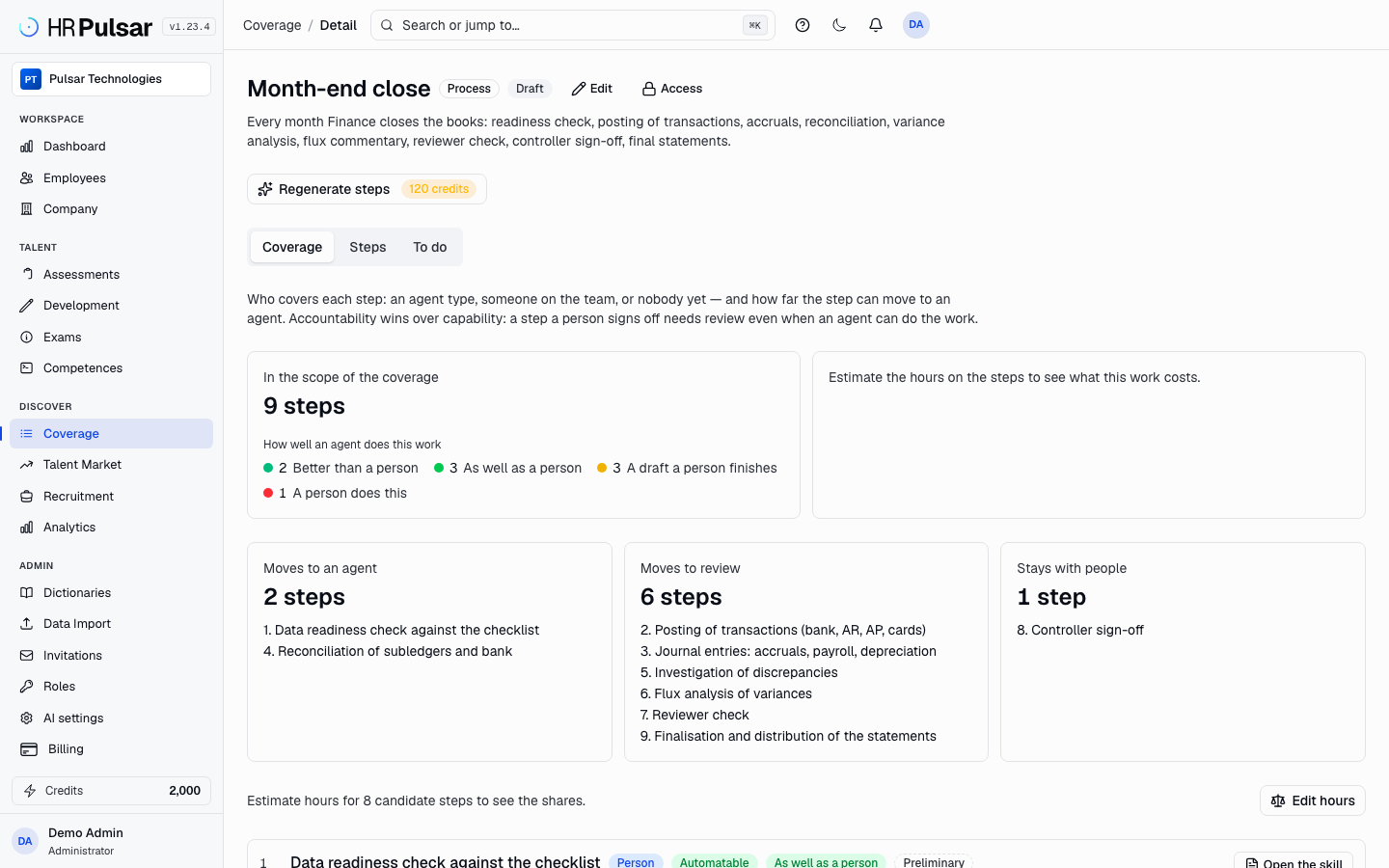
Steps, as you describe them.
Two calls: one splits your description into an ordered list of steps, one tags every step with the capabilities it requires from a fixed catalog of seventeen. Rename, reorder, add or delete steps; change any chip; accept the breakdown when it matches reality.
Every chip shows the model's confidence and the fragment of your description it relied on. A doubtful chip is a suggestion until you confirm or remove it, and a step can be reclassified by telling the model what it really is.
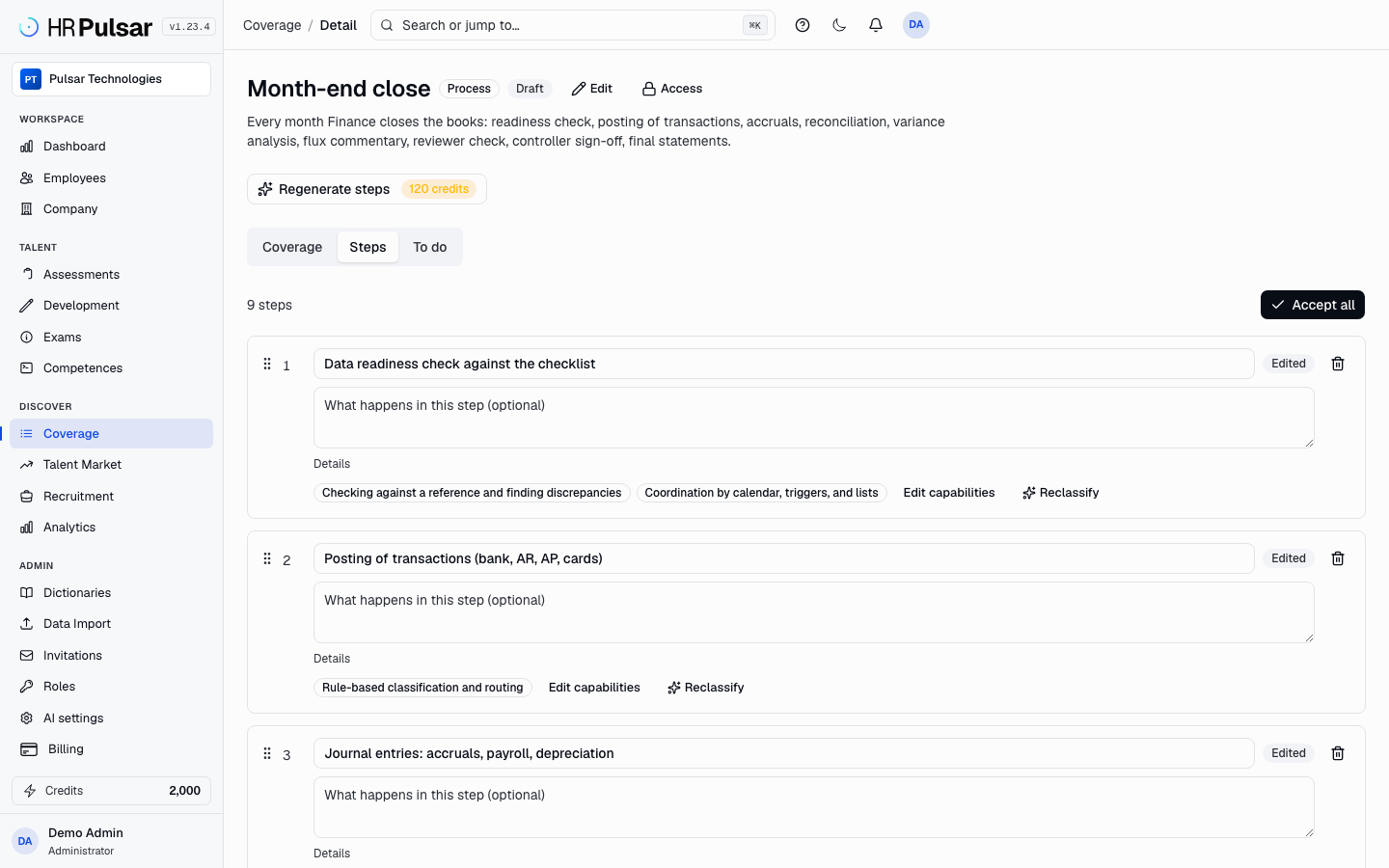
Counted in hours, not in steps.
Each step carries the model's estimate of hours per run and runs per year; you correct it in place. One hourly rate on the company profile turns hours into money. Until you set it, the screen shows hours only.
The share of the work that moves to an agent, the share that moves to review and the share that stays with people are counted on your own hours, for your own process. No number on this site says what share of your work an agent can take.
What the agent itself costs is deliberately absent. The skill runs in your own tools, so we never see its usage, and the screen says so.
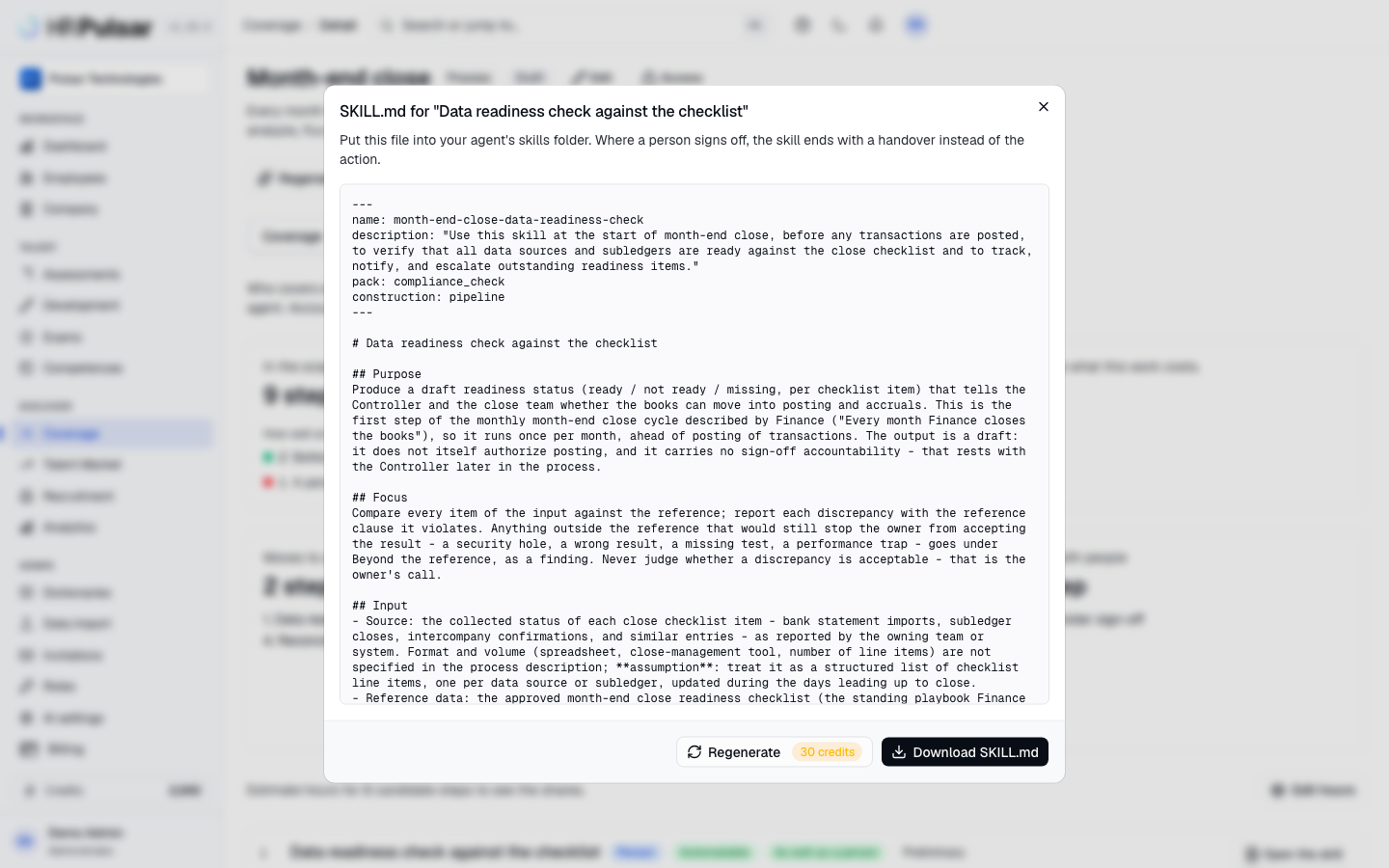
A skill file per step, run in your own tools.
For any step an agent can take, generate a SKILL.md: the pack's skeleton filled with your company's competence indicators, the step's attributes and its acceptance point. Preview it, download it, or register the agent you already run for that step.
The platform hands over the file and executes nothing. Nine built-in agent types describe what an agent can do in the same seventeen capabilities a person is assessed on.
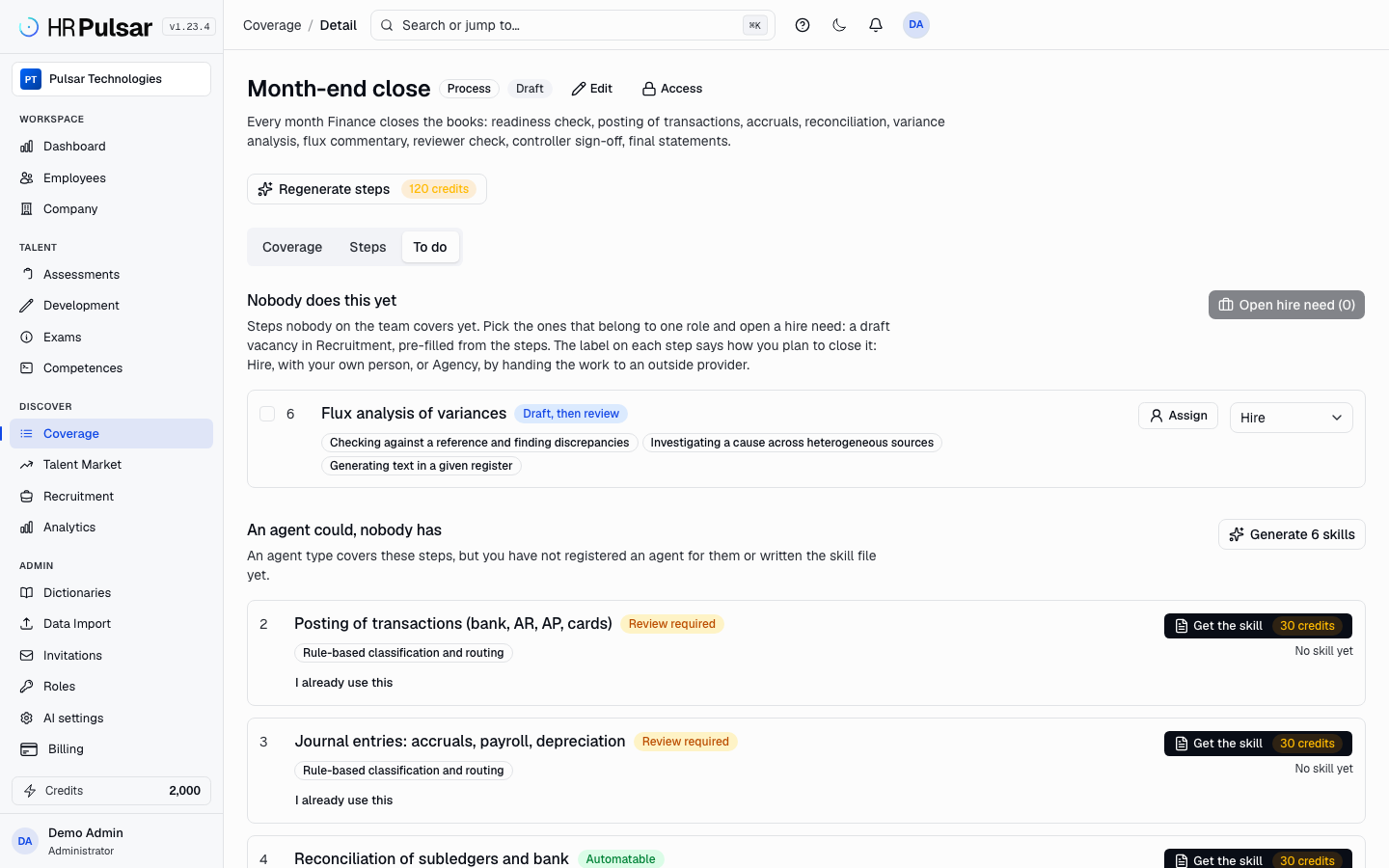
A gap is a vacancy.
Everything the breakdown leaves unclosed sits in one list. Steps nobody covers open a hire need: a draft vacancy in Recruiting with the steps as its description and the closest competences pre-filled. Or look inside the company first, or give the work to an agency.
Steps an agent could take, where you have registered no agent and written no skill file, get the file generated: one at a time, or all of them at once.
Built on the platform.
Coverage reads the data the talent platform already keeps: the competence framework, the assessments, the grades, the vacancies. One skills model for people and agents, not a second one.
Competencies
Your competence indicators fill the skill file, and the capability chips map onto the framework you already have.
Learn more →Assessments and grades
A person covers a step by completed assessments against the passing score of their grade, or by the competence matrix of their position.
Learn more →Recruiting
A gap opens as a draft vacancy here, with the steps as its description and the closest competences pre-filled.
Learn more →Access
A process is seen by the whole company or only by the roles, positions and people you name. Changes stay in its history.
What we measure →Seventeen capabilities, each with a dated verdict.
Every verdict on the screen rests on a public list: seventeen capabilities derived from 39 published processes and 390 steps. Thirteen a model can attempt, with a dated verdict on each; four it cannot touch.
Describe one process. Get three lists.
The demo opens on Coverage with two processes already broken down: read the verdicts, correct the hours, download a skill file. Or send us one of yours and we return the lists by hand.