
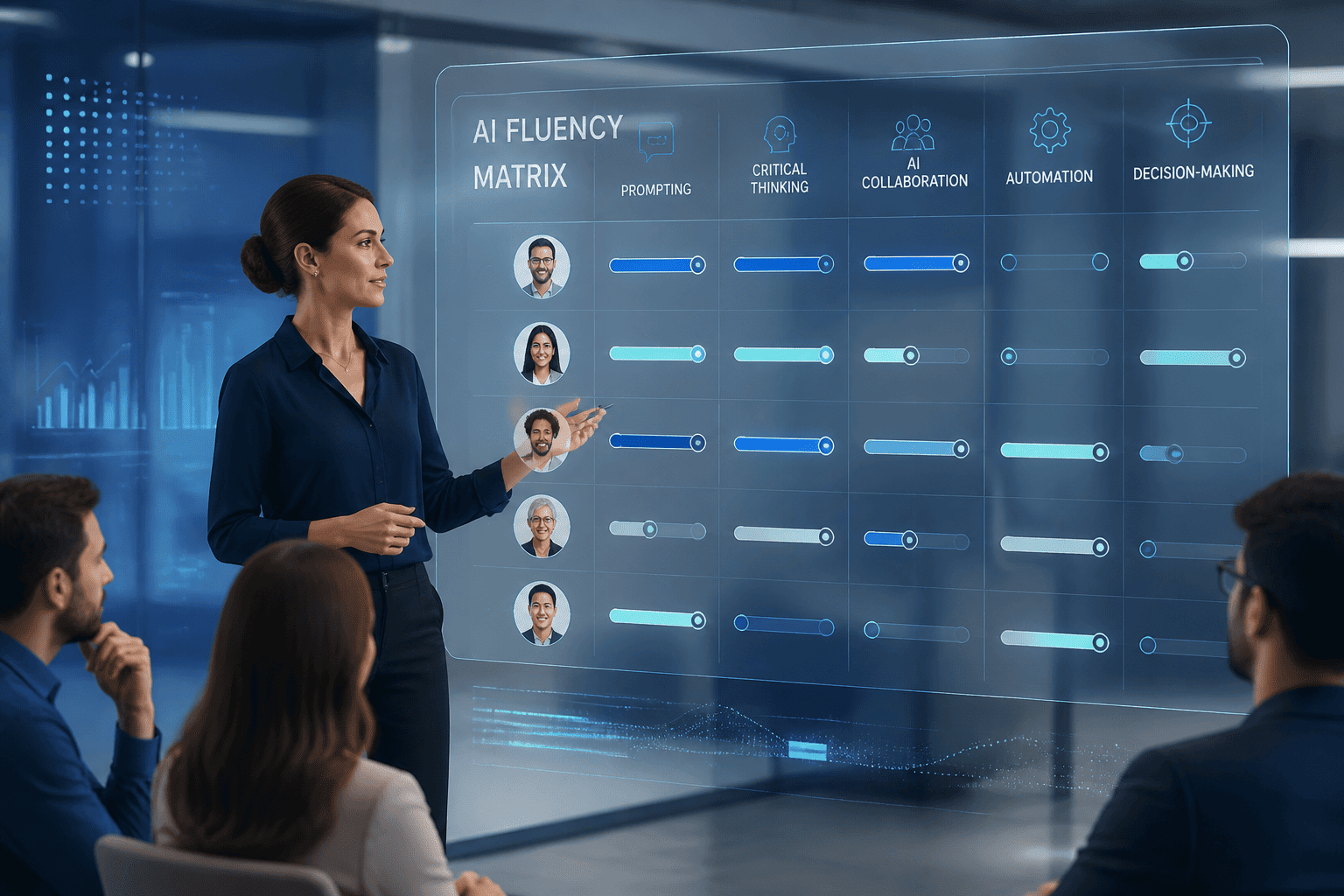
When CEO asks a reasonable question: “How AI-capable is our team?” HR exports a spreadsheet. Columns appear:
Department
Role
Seniority
“Uses AI” — Yes/No
Which is approximately as informative as evaluating engineering maturity with: “Uses computers” — Yes.
The problem is not lack of enthusiasm. Most companies genuinely want to understand AI adoption.
The problem is measurement. Because AI fluency is not a software licensing question. It’s an operational capability question. And most organizations still evaluate it using methods designed for LMS completion tracking and annual competency reviews.
That model breaks immediately once AI becomes part of daily execution.
AI fluency is not equal to AI usage
This is the first thing organizations need to separate clearly.
An employee occasionally rewriting emails with ChatGPT is not operating at the same level as someone orchestrating multi-agent workflows or evaluating outputs from autonomous agents.
Yet many organizations flatten all of this into: “AI adoption.” That metric becomes useless very quickly. Especially in companies where workflows increasingly depend on AI systems operationally.
This is why the Hoffman AI fluency framework matters.
Not because organizations need another trendy maturity model. The internet already produces enough “innovation pyramids” to wallpaper a WeWork.
The framework matters because it describes behavioral differences in how people work with AI systems.
Most AI fluency assessments fail for predictable reasons
Usually one of three things happens.
1. Self-assessment only
Employees rate themselves.
Result: Half the company becomes “advanced.” Somebody who discovered prompt templates last Thursday now identifies as an “AI strategist.”
Confidence is measurable. Capability less so.
2. Tool-centric evaluation
Organizations measure number of AI tools used: frequency of usage & subscription adoption
This also fails. Using five AI tools badly is not fluency.
It’s browser tab accumulation.
3. Certification theater
Mandatory training.Completion badges.Forty-minute webinars.Quiz at the end.
⭢ Everyone passes. Nothing changes operationally.
Result: The company now has “AI-certified employees” who still cannot supervise outputs reliably.
Which is mildly concerning when AI systems participate in
hiring, evaluation, or reporting workflows.
A useful AI fluency model measures behavior, not enthusiasm
AI fluency should describe how employees:
structure workflows
supervise outputs
delegate tasks
validate information
And also:
how consistently they operate AI systems
how safely they handle risk
Not whether they “believe in AI.” Nobody needs workplace astrology for copilots. A practical framework should evaluate observable behaviors.
The three operational layers of AI fluency
The simplest useful structure still maps closely to the three-level model popularized by Reid Hoffman.
Level 1 — Assisted work | Level 2 — Structured workflows | Level 3 — Orchestration and supervision |
|---|---|---|
Employees use AI reactively:
| At this level, employees stop “using AI occasionally” and start integrating it into operational routines, build repeatable systems around AI. | Advanced fluency is not “better prompting.” It’s system orchestration. |
Behavioral markers:
| Behavioral markers:
| Behavioral markers:
|
This level matters because it creates early exposure to:
⭢ Most organizations already operate here whether policy acknowledges it or not. | This is where asymmetry appears inside teams. One employee suddenly performs at 3x leverage because they built reusable cognitive infrastructure around their workflow. This is also where companies start needing:
Otherwise business-critical AI systems remain undocumented until the employee maintaining them leaves. | At this level, the employee increasingly acts as:
The work shifts from generating outputs to supervising systems generating outputs. This distinction matters enormously in HR and operational environments. Especially where:
Advanced AI fluency without supervision discipline becomes operational risk very quickly. |
A useful AI fluency assessment combines multiple signals. Not just surveys, telemetry or manager opinions. You need blended evidence.
How to check?
Check your level now
Layer 1. Start simple. Ask workflow questions instead of abstract confidence questions.
Bad question: “How experienced are you with AI?” - Everyone suddenly becomes “expert.”
Better questions:
Do you maintain reusable AI workflows?
Do you validate AI-generated outputs systematically?
Do you use role-based prompting?
Do you delegate recurring tasks to AI systems?
Have you built persistent agent structures?
Do you supervise outputs from multiple models differently?
Can you explain where hallucination risk appears in your workflow?
The conversation becomes operational. Not aspirational.
Layer 2: Workflow evidence
AI fluency should connect to actual workflow patterns:
recurring automation usage,
persistent agent structures,
tool diversity,
workflow reproducibility,
review discipline,
escalation patterns.
The goal is not monitoring employees like warehouse inventory. The goal is understanding operational topology.
A modern company increasingly runs hybrid workflows, distributed cognitive systems and semi-autonomous execution layers. Ignoring it creates inaccurate workforce models.
Layer 3: Peer and manager validation
This layer matters because AI fluency affects team operations visibly. People usually know:
who built the automation everybody relies on;
who supervises outputs carefully;
who understands model limitations;
who quietly became workflow infrastructure.
Peer validation often surfaces operational influence much more accurately than formal titles.
Especially in technical organizations.
Layer 4: Practical evaluation
The most reliable signal is still observed execution.
Can the employee:
structure workflows efficiently?
detect hallucinations?
supervise outputs?
orchestrate multiple systems?
explain governance tradeoffs?
evaluate AI-generated reasoning critically?
This matters far more than theoretical vocabulary.
Someone using “agentic workflows” in every sentence is not necessarily fluent. Sometimes they just spend too much time on LinkedIn.
AI fluency without governance is incomplete
A highly AI-capable employee who ignores governance creates risk. Especially in HR analytics, legal review, finance operations.
Practical fluency now includes:
data awareness,
supervision discipline,
escalation judgment,
policy understanding,
regulatory awareness.
That’s why AI fluency increasingly intersects with shadow AI audit processes, AI governance, operational risk management and emerging AI Act HR compliance requirements.
AI workflows evolve weekly. Competency systems designed like PDF archives cannot keep up with operational reality.
This is why workforce infrastructure increasingly needs:
graph-based models,
extensible schemas,
workflow-aware competencies,
API-first architecture,
event-driven updates.
In practice, a modern skills-first HR platform increasingly behaves more like operational infrastructure than administrative software.
Especially in companies running complex human + AI workflow management systems.
The technical architecture matters too
Eventually technical teams ask: “Should we build this internally?”
Possible? Sure. If you want to do this, we wrote about all the pitfalls of this process here.
The only thing we will repeat here: extensibility matters more than polished screenshots. A serious HR system should support:
OpenAPI access;
MCP compatibility;
plugin systems;
custom workflow ingestion;
AI governance hooks;
extensible competency models.
Because organizations evolve AI workflows faster than traditional HR vendors evolve schemas.
The point is not ranking employees
AI fluency assessment should not become corporate gamification or another performance-review ritual people learn to optimize politically.
The goal is operational clarity. Understanding:
❓where advanced workflows exist
❓where dependency accumulates
❓where governance gaps appear
❓where enablement is needed
❓where supervision capability is weak
❓where organizational leverage already exists
Because companies already have an AI workforce. Most just haven’t mapped it yet.
And organizations that fail to understand their AI operating layer will eventually manage workflows they cannot fully see. Historically, that never ends elegantly.