
Your manager says: “Our team already uses AI.” Good start.
But then you ask what that actually means. Usually the answer collapses immediately.
One employee occasionally rewrites emails with ChatGPT. Another runs autonomous research agents connected to internal APIs. A third built an evaluation pipeline that reviews outputs from other AI systems before humans even see them.
All three get classified as: “Uses AI.”
This is like calling Excel formulas and distributed databases the same thing because both technically involve computers.
That’s why Reid Hoffman’s framing around AI fluency matters. Not because executives needed another maturity model. The internet already has enough pyramids, quadrants, and circles pretending to explain the future of work.
What Hoffman describes is more operational than inspirational.
AI fluency changes how work is performed. And increasingly, how organizations are structured.
The real shift is not tool adoption.
It’s workflow architecture.
Most companies still measure AI maturity incorrectly. They ask: “How many ChatGPT licenses do we have?” or “Which teams adopted copilots?”
These metrics are shallow. AI fluency is not about access to tools.
It’s about the relationship between humans and cognitive systems inside actual workflows.That relationship evolves in stages. And each stage changes: productivity, supervision requirements, organizational risk, hiring expectations, workforce structure, compliance exposure.
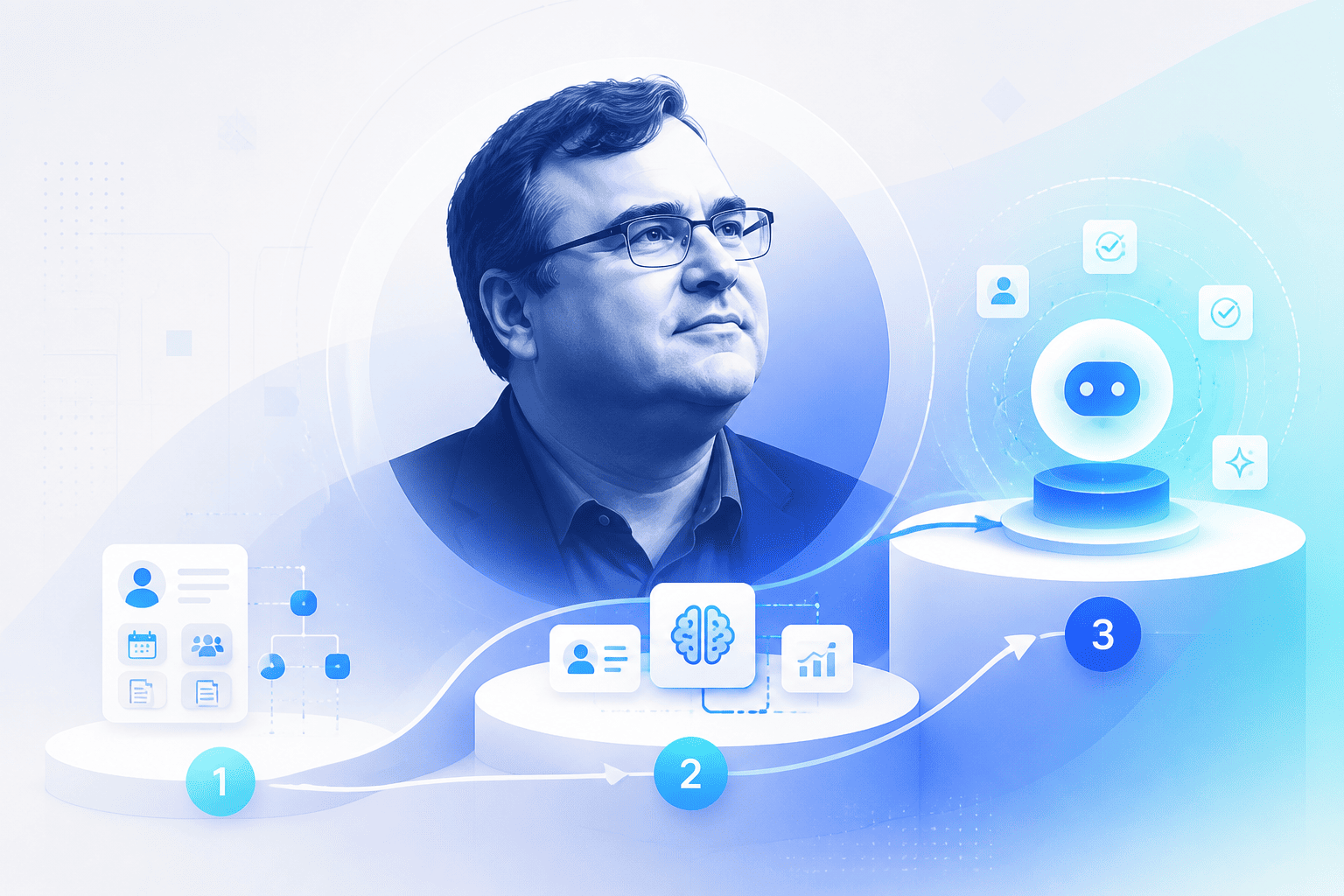
This is where the Hoffman AI fluency framework becomes useful. As workforce infrastructure logic.
Level 1: AI as assistant
This is where most organizations currently are. Employees use AI reactively:
|
|
|
|---|
The workflow still revolves around the human. AI acts as acceleration.
Level 1 users treat AI like a calculator for language and knowledge work
Organizations often mistake Level 1 adoption for organizational AI maturity. It isn’t.
A company where employees occasionally use ChatGPT is not necessarily AI-native. It’s just AI-aware.
At this stage, the biggest problem is usually visibility. Nobody knows:
⚠️ which tools employees use
⚠️ where company data goes
⚠️ which workflows depend on external models
⚠️ which teams rely on AI operationally
This is where conversations about shadow AI audit and internal AI tools registry systems start becoming necessary.
Because shadow AI begins at Level 1 long before leadership notices it.
Level 2: AI as workflow layer
Employees stop using AI occasionally and start building repeatable systems around it.
The interaction changes from: “Help me with this task” to “Operate this workflow with me continuously”.
Now people create
persistent prompt systems reusable templates role-based agents structured automations
AI-supported decision flows workflow memory
This is where productivity differences become dramatic: two employees with identical titles suddenly produce radically different outputs because one built operational leverage around AI systems.
Same salary band, but different execution model - welcome to the beginning of workforce asymmetry!
Level 2 employees become infrastructure nodes. Intermediate AI fluency creates organizational dependency.
The employee who builds the recruiting automation flow, the sales research pipeline or the AI-assisted reporting stack quietly becomes operational infrastructure. Usually undocumented operational infrastructure.
Which means:
✅ knowledge concentration increases
✅ workflow transparency decreases
✅ replacement difficulty rises
✅ governance complexity appears
This is where competency systems break if they still model work only through job titles.
For example “recruiter” no longer describes operational capability accurately. The real capability may look closer to "sourcing strategist" or "workflow architect".
That’s why organizations increasingly need:
an AI workforce catalog,
competency graphs,
AI workflow visibility,
and more serious AI workforce management models.
Otherwise leadership discovers business-critical AI workflows only after the employee maintaining them resigns. Then everyone opens Notion and starts digital archaeology.
Level 3: AI as coordinated system
This is where the model changes fundamentally. Advanced AI fluency is not about prompting better. It’s about orchestrating systems of agents, tools, evaluations, and workflows.
At Level 3
|
|
|---|---|
|
|
The role shifts from operator to conductor. Hoffman uses this framing intentionally because advanced AI work increasingly resembles coordination, not execution.
What Level 3 actually looks like
Not sci-fi. Usually something much more practical.
Examples:
Agents generating candidate shortlists while humans review edge cases
AI systems evaluating outputs from other AI systems
Automated workflow routing based on confidence scoring
Organizational knowledge systems maintained collaboratively by humans and agents
Internal copilots connected through MCP-compatible infrastructure
At this point, the employee’s value shifts heavily toward judgment, supervision, system design, governance, exception handling and strategic direction.
Ironically, advanced AI fluency becomes less about “using AI” and more about understanding where AI should not operate autonomously.
That distinction matters a lot in HR contexts. Especially around hiring, promotion and compensation.
Because probabilistic systems making decisions about careers without oversight is how regulators start writing documents with very long titles.
AI fluency is becoming part of professional identity
There’s another shift happening quietly. Employees increasingly want portable proof of AI capability.
Not generic certifications - operational credibility.
People want to demonstrate:
|
|
|---|
This is partly why public AI fluency profiles and badges are emerging.
The market currently lacks trusted ways to represent most of it. Resumes do a terrible job here.
Everyone suddenly claims to be an “AI strategist.” Usually after discovering prompt templates two weekends ago.
A structured fluency model is imperfect. But still significantly more useful than self-declared expertise.
Compliance will force organizations to formalize this anyway
Many companies still treat AI fluency as optional learning. Regulation will probably change that.
Once AI systems influence -> | Organizations need -> | Which means understanding |
|---|---|---|
|
|
|
This is where law HR compliance intersects directly with workforce architecture. And where static HR systems start looking painfully outdated.
Build-vs-buy
Technical leaders reading this usually arrive at the same thought: “We could model AI fluency internally.”
Technically? Yes.
Then reality arrives:
☑ workflow taxonomies
☑ competency mapping
☑ auditability
☑ extensibility
☑ governance
☑ scoring systems
☑ APIs
☑ integrations
☑ verification models
☑permission layers
This is why extensibility matters more than marketing promises.
AI workflows evolve too quickly for rigid HR architecture and companies increasingly need workforce systems that understand humans and AI agents as part of the same operational topology.
That’s also why an open source HR system becomes attractive for technical organizations. Governance requirements evolve faster than proprietary roadmaps.
The important part is not the labels
The point of Hoffman’s framework is not turning AI fluency into another corporate certification ritual.
Nobody needs mandatory AI webinars, “AI Champion” Slack emojis, or quarterly fluency town halls with inspirational background music.
The value comes from operational clarity.
Because the workforce is already changing.
Most companies simply still describe it using language from before AI became part of daily execution. That gap won’t stay abstract for long. Not once workflows, compliance, hiring, and organizational design all start depending on it simultaneously.