
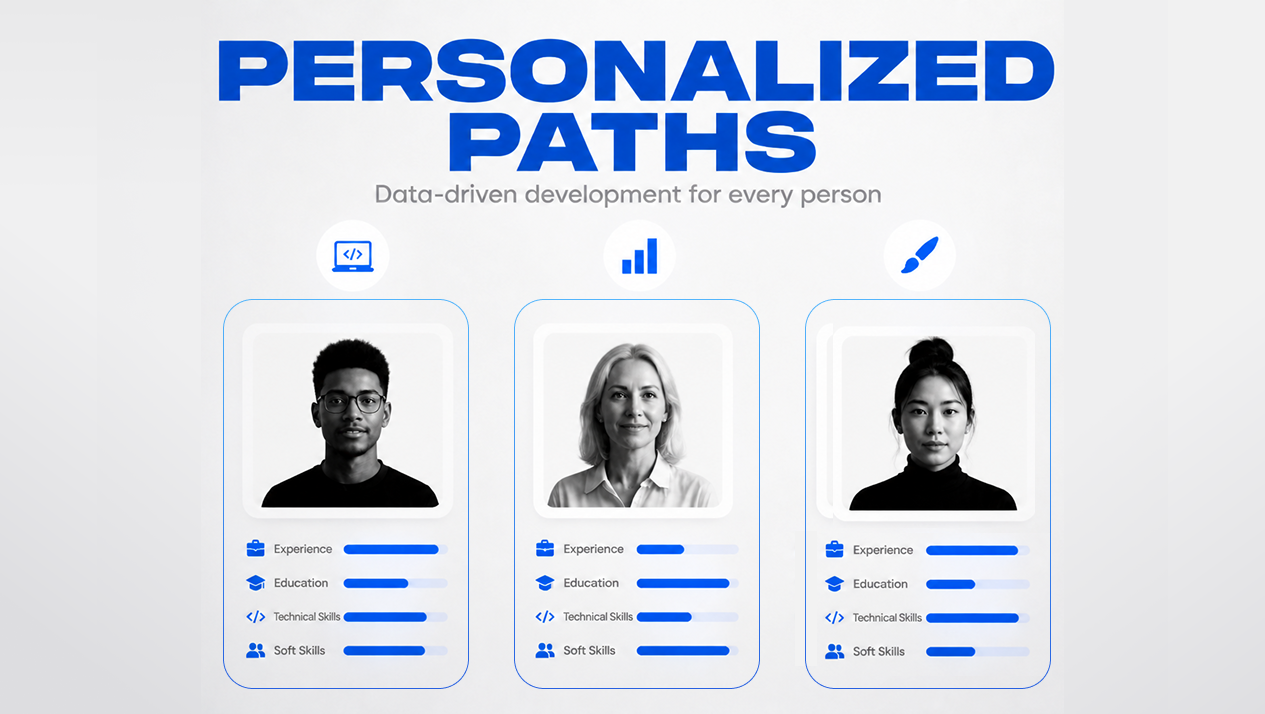
One onboarding checklist development path for everyone. That's how most companies still hire. Then they wonder why retention is a problem. What's changed?
Well, the newer HR systems, the HRIS platforms, they’ve started moving away from this one-size-fits-all idea. They’re actually using data now. They look at your specific role, what you’ve done before, what skills you bring to the table, and even what your personal goals are. And based on all that, they personalize.
Modern HRIS platforms stopped treating employees as a single cohort. They use data: role, background, skills, goals. And they personalize.
The onboarding for someone joining engineering is going to be completely different from someone joining the sales team. And even within engineering, a backend developer is going to need training on different tools than a frontend developer. It’s not rocket science. Likewise, someone who’s been in the professional world for a decade doesn’t need the same kind of hand-holding and growth plan as someone who’s just starting out in their career.
This really should feel obvious, right? But you’d be surprised how many companies are still stuck in that old way of thinking.
Let’s look at some real-world examples.
There’s this SaaS company, about a hundred employees strong. They actually track skill gaps for each role. Their data showed that their junior designers really needed more training on design systems, while the senior designers would benefit more from coaching on task setting and time management skills. So, they created two distinct development paths. And you know what? Satisfaction with work and training within the design team went up by 28%. That’s a pretty significant jump, just from looking at what people actually needed.
Then there’s a fintech startup. They actually import competency frameworks right when someone is hired. So, a new engineer comes in, and their onboarding is customized based on their existing knowledge. The system might say, "Hey, you already know distributed systems really well, so you can totally skip this module. But you don’t have much experience with our specific tech stack, so you’ll want to deep dive into this section." This meant their week one productivity shot up because they weren’t wasting time on things they already knew.
Another company, a marketplace platform, started measuring how quickly different groups of employees picked up new skills. They noticed something interesting: people who were hired in the first quarter of the year seemed to develop faster than those hired in the third quarter. It turned out that the mentoring and training provided during the first quarter was just better. ⭢ So, they took what worked in Q1 and applied it to everyone else. They solved a problem using actual data, instead of just making assumptions or guessing.
So, why is all of this so important? It boils down to how people feel.
When employees feel like they’re just another generic person in a sea of employees, getting the same training, the same feedback, and the same development opportunities as everyone else, they tend to disengage. They start to feel like just another row in a spreadsheet.
But when a company makes an effort to personalize things, it feels like someone is actually paying attention to you as an individual. It feels like you’re seen. And that feeling of being recognized and valued makes a huge difference in how long people choose to stay with a company. The data consistently shows that companies that embrace this kind of personalization have much better retention rates.
Here’s the part that might be a bit of a hurdle. To really do this well, you need data. You have to know things like:
- Who has what skills right now?
- Which direction are people actually trying to grow in?
- And what kind of training or support works best for different types of individuals?
A lot of smaller companies tend to skip this step. They’re usually swamped with other immediate tasks, so gathering and analyzing this kind of data feels like too much. And then, when people eventually leave, they’re caught off guard, wondering why.
The key here is to not get overwhelmed. You don’t have to do everything at once. Start small. Maybe just track three key things. Use those three things to personalize just one aspect of the employee experience. And then, build from there. It’s a gradual process and to make it at least a little easier and more enjoyable we are making HR Pulsar free for comprehensive use by companies with a small staff.