
This week a post appeared on Hacker News: “Ask HN: How to break Claude Code addiction?”. The author is a professional developer who works remotely. By the end of the day he stops reading the code the agent writes and keeps going, “one more bit”, late into the night. This did not happen before.
Our team digest bot, which reads HN and posts a morning summary to Slack, turned it into “companies depending on a single tool”. This is how a topic gets inflated: a personal observation becomes a corporate risk after three retellings.
The post is not alone, people really write a lot about Dev skill-atrophy. Self-tests are already appearing. When a small industry of diagnostic tools appears around a symptom, the symptom is probably real.
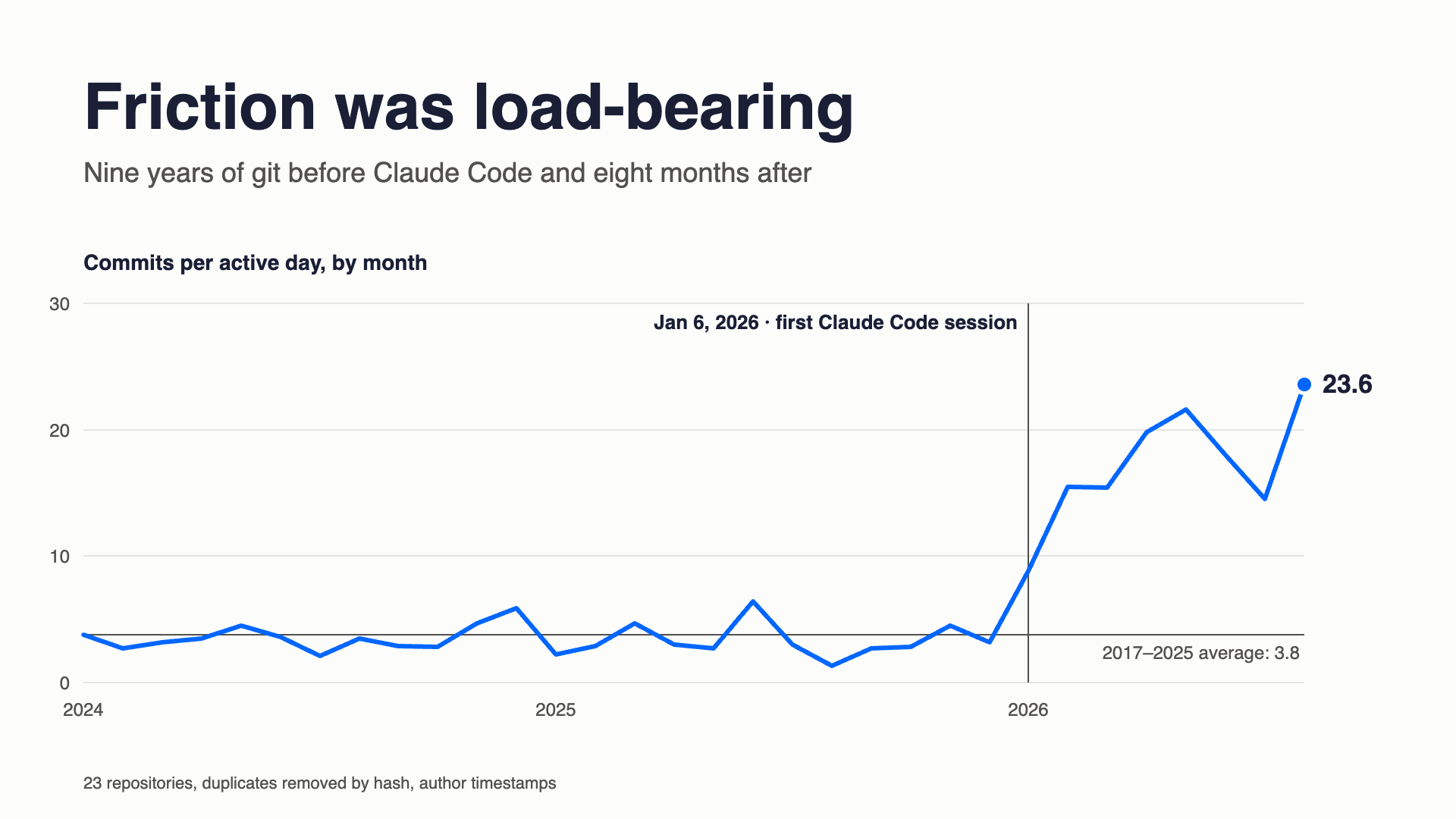
I decided to check on myself. I have something none of the studies I found have: nine years of commit history without AI and eight months with Claude Code, on one person, with an exact start date.
— Maxim Berg, Founder HRPulsar
What the numbers say:
36% of my commits now land outside working hours (nine-year average: 22%)
the median commit is almost four times bigger
my median reply to the agent is four minutes. The slow link in the loop is me.
*One caveat on the baseline: Max is not only a developer — he also run the business, management fills the daytime, and coding often slides into the evening.
I'm not stopping. This is a deliberate trade: I ship HRPulsar fast, 104 releases since April. But the line I hold that control lies in the process, not the tool. The agent does not release. Tests replace reading every diff. In December I will publish the same metrics again so the numbers reveal what impressions miss.
— Maxim Berg, Founder HRPulsar
The metric Multitudes reports for the industry (a 19.6% rise in out-of-hours commits) looks like this: from a 22% average to 36%, in absolute terms from about 13 to about 160 commits a month.
It is worth considering that: with an agent, commit granularity is different — there are simply more commits for the same work. But the median commit also got almost four times bigger, so the volume grew either way. By how much exactly - cannot say.
And one result we did not expect. The HN author describes how in the evening he slides from engineering into vibe coding: he stops reading and only presses “continue”.
I checked this on my own median prompt length: flat month to month. Hours went up, but the quality of my control over the agent does not drop.
— Maxim Berg, Founder HRPulsar
Friction was load-bearing. Typing code limited the working day, forced planning before coding, forced understanding. The agent removed the effort, and nobody noticed the effort was also the limiter.
Check what's your out-of-hours share, before and after the agent. we are sure that one number beats any feeling.